
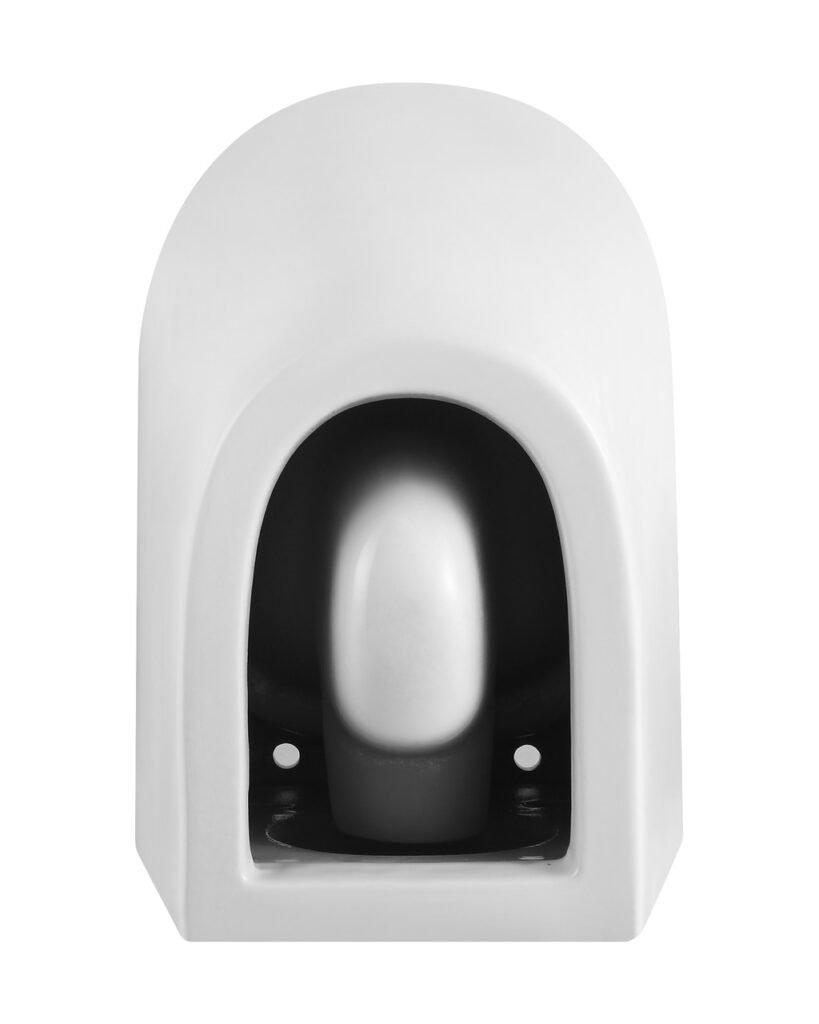
A wall-hung pan is held by the frame, not the wall
A wall-hung pan has no visible support. There is no pedestal, no foot and no skirt carrying it to the floor. Everything the fixture does, including the weight of a person sitting on it, passes through the fixing points at the back and into whatever those fixings are attached to.
That structure is the frame. It is not part of the ceramic and it is not usually part of the ceramic order, but it is the component that decides whether the installation is sound. A wall-hung pan treats the frame as the load path, and the wall behind the frame as the thing the frame is anchored to.
What the frame actually carries
A frame carries three things at once, and only one of them is the pan. Naming all three is what turns a vague structural worry into something a project can check.
- The dead weight of the pan and, where the cistern is inside the wall, the water it holds.
- The live load applied when somebody sits, leans or stands up, which is larger than the static weight and is applied repeatedly.
- The load path into the wall: the anchors, the studwork or the wall build, and the connection between them.
That third item is where most of the risk sits, because it is building work. A frame that is well made and well rated still fails if it is anchored into something that was not built to take the load. The frame and the wall have to be considered as one system, and they are usually supplied by two different parties.
What a load rating is, and what it is not
A frame is normally published with a load rating, and buyers reasonably read it as an answer. It is a partial answer. A rating describes what the frame itself was tested to withstand, under the conditions and method of whoever issued the rating. It does not describe your wall, your anchors or your installation.
A rating is therefore a statement about a component, not a certificate for an installation. It tells you the frame is not the weak link when it is fixed as intended. It says nothing about a stud wall that was never built for the purpose, or a fixing pattern that was changed on site because a service was in the way.
This is also why a ceramic supplier should not present a rating as its own promise. The frame is not made by the ceramic factory, and the ceramic body is not the load-bearing element. Our own part in a wall-hung installation is a fired body that is made to be fixed to a suitable frame, and that is the limit of what we can confirm.
Who confirms the frame suits the pan
Two confirmations are needed, and they are often confused for one. The first is that the pan’s fixing points match the frame. The second is that the frame’s capacity suits how the installation will actually be used, in the room it will be used in.
- The pan manufacturer confirms the fixing geometry of the body: where it is intended to be fixed.
- The frame manufacturer confirms the structure: what the frame is rated for and how it must be anchored.
- The project confirms the wall: the build-up, the studwork and the fixing that will carry the frame.
Where a project expects one supplier to carry all three confirmations, it will usually be disappointed, because no single party has the information. The productive version of the conversation names the three questions and routes each to the party who can answer it.
The wall build, and why it decides more than the frame
A frame has to be anchored, and the anchor needs something solid behind it. In a solid wall that is straightforward. In a stud or framed wall, the depth and the thickness of the construction decide what is possible, and in some constructions a frame cannot be anchored directly at all without additional structure.
There is a second consequence. A wall-hung installation needs a service zone behind the finished surface for the frame, the cistern and the outlet. That zone has to be built in, not added later, and its depth is decided before the frame arrives. Once the wall is closed and tiled, the inside of that zone is unreachable, which is why the build has to be right the first time.
Where the wall cannot provide what the frame needs, the correct answer is usually a change to the wall rather than a change to the fixture. Trying to solve it at the pan end produces an installation that looks finished and behaves badly, and the fault appears only when somebody actually uses the fixture.
Checks before tiling begins
Everything that matters in a wall-hung installation is hidden by the time the job is finished. The checks therefore have to happen while the wall is still open, and they belong on a short list that somebody signs.
- The frame is anchored into the structure it was specified for, with the intended fixing pattern.
- The fixing points on the frame line up with the fixing points on the pan of the exact model ordered.
- The outlet leaves the pan at the height and angle the frame and the drainage require.
- The service zone is deep enough for the frame, the cistern and the outlet without preloading anything.
- The finished surface will sit where the flush plate expects it, so the mechanism still operates.
Each of these is checkable in minutes while the wall is open and impossible to check once it is closed. That asymmetry is the whole argument for doing the work at this stage rather than at handover.
What to put into an order
An enquiry for a wall-hung pan should describe the installation as well as the product, because the two are tied together. Four lines are enough for a supplier to answer usefully rather than generically.
- The printed model code and the mounting arrangement, so the reply is about a specific pan.
- The frame and cistern already selected, if any, and who is supplying them.
- The wall construction, since it decides whether a direct anchorage is available.
- The destination market, because the document set that settles the question depends on where the goods are going.
On our own wall-hung pans the cistern is supplied by the installer, and the pan is made to be fixed to a suitable frame and to receive a dual-flush wall plate. Our bodies are fired in our own tunnel kiln at Chaozhou, where casting, glazing, firing, QC and export run in the same plant: a factory established in 2021, with the plant covering 51,000 m² and 285 people. We can confirm what the body is made to be fixed to. The structural confirmation belongs to the frame and the project.
Why this is a project question before it is a product question
The pan is the visible part of a wall-hung installation and the smallest part of its engineering. The frame, the anchors and the wall do the work. That makes the fixture a late decision in a process that begins with the wall.
A buyer who understands the order of decisions asks about the wall first, then the frame, and only then the pan. A supplier who is asked about the pan first can answer only part of the question, and the gap is filled on site by whoever is standing there.
Read a wall-hung installation as a chain with one visible link. The ceramic body is what gets specified, photographed and shipped. What holds it up is the part nobody photographs, and it is the part to get right.
Frequently asked questions
Does a wall-hung toilet need a frame?
Yes. A wall-hung pan has no support to the floor, so its load passes through the back fixings into a frame and from the frame into the wall. The frame is a separate product from the ceramic body and is normally supplied by a different manufacturer. The pan is made to be fixed to one.
What does a frame load rating tell me?
It describes what the frame was tested to withstand, under the method of whoever issued the rating. It is a statement about the component, not about your wall or your anchors. A rated frame on an unsuitable wall can still fail, which is why the rating is one input rather than the answer.
Who confirms the frame is suitable?
Three parties, on three different questions. The pan manufacturer confirms the fixing geometry of the body. The frame manufacturer confirms what the frame is rated for and how it must be anchored. The project confirms the wall that will carry it. No single supplier holds all three answers.
Can a wall-hung pan be fitted to a stud wall?
Often it can, but it depends on how the wall is built and whether the frame can be anchored into something that takes the load. That is a building question rather than a product question, and it should be answered from the wall construction before the frame is ordered rather than assumed afterwards.
What has to be checked before tiling?
That the frame is anchored as specified, that its fixing points match the pan’s, that the outlet leaves the pan where the drainage needs it, that the service zone is deep enough, and that the finished surface will sit where the flush plate expects. All of these are hidden once the wall is closed.
Does the ceramic body take the load?
No. The body is made to be fixed to a frame and its job is to connect to it properly. The load passes through the fixing into the frame and the frame passes it into the wall. Presenting a ceramic body as a load-bearing element confuses the fixture with its support.
Related on this site
Documents and certificates
- Catalogues, drawings and test reports
- The plant, the kiln and the QC record
- Ask about the fixing detail on a pan
Related reading
- Wall-hung toilets in projects
- Concealed or exposed cistern
- Flush Plates and Actuators: Choosing the Interface