
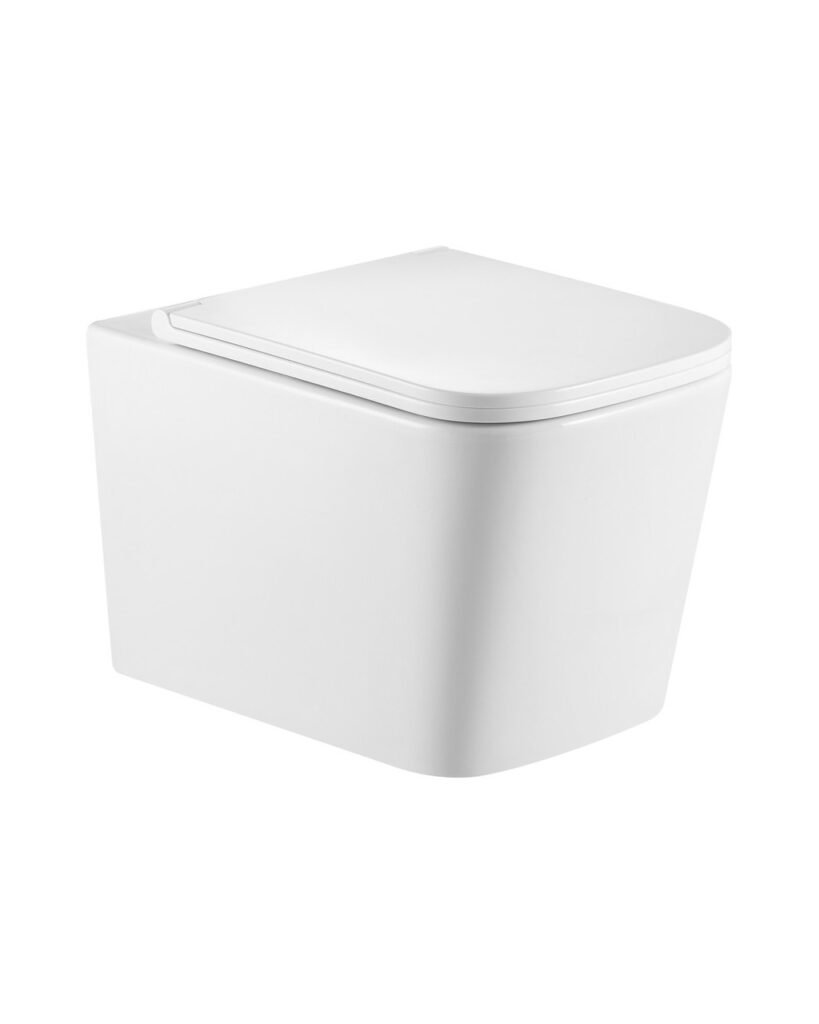
Why projects choose wall-hung
Wall-hung toilets lift the bowl off the floor, which does two things buyers care about: the bathroom floor cleans in one uninterrupted pass, and the visible footprint shrinks. That is why they are the default in European hotel bathrooms and increasingly specified in commercial washrooms and higher-end residential across the Middle East and Southeast Asia.
The trade-off buyers must plan for
A wall-hung toilet is not a standalone product — it is a system. The ceramic bowl hangs on a concealed in-wall cistern frame, and the flush is operated by a wall plate. That means the wall structure, frame and bowl must be specified together, and the builder installs the frame before tiling. Projects that discover this late pay for rework.
Plan for: frame and cistern compatibility, wall-plate selection to match the bowl profile, and a load-rated installation for the finished weight. A competent supplier provides the bowl dimensions and fixing centres in the spec sheet, not as an afterthought.
What to verify in the spec sheet
- Fixing centres and frame compatibility in millimetres
- Dual-flush function and the cistern volume used
- Bowl projection from the wall — critical in small washrooms
- CE marking for EU projects and WaterMark for Australia / New Zealand
Working with a ceramic manufacturer
Sheng Ge produces wall-hung bowls in two profiles — models 2303 and 2381 — and carries CE certification for wall-hung toilets, downloadable from our Certifications page. If your project specifies wall-hung, send us the frame brand and the flush plate model you intend to use, and we will confirm the matching bowl and provide the spec sheet before you commit to samples.
Related on this site
- 2303 — one of our two wall-hung profiles
- 2381 — the other wall-hung profile
- CE certificate for our wall-hung toilets (PDF)
- Send the frame brand and wall-plate model