
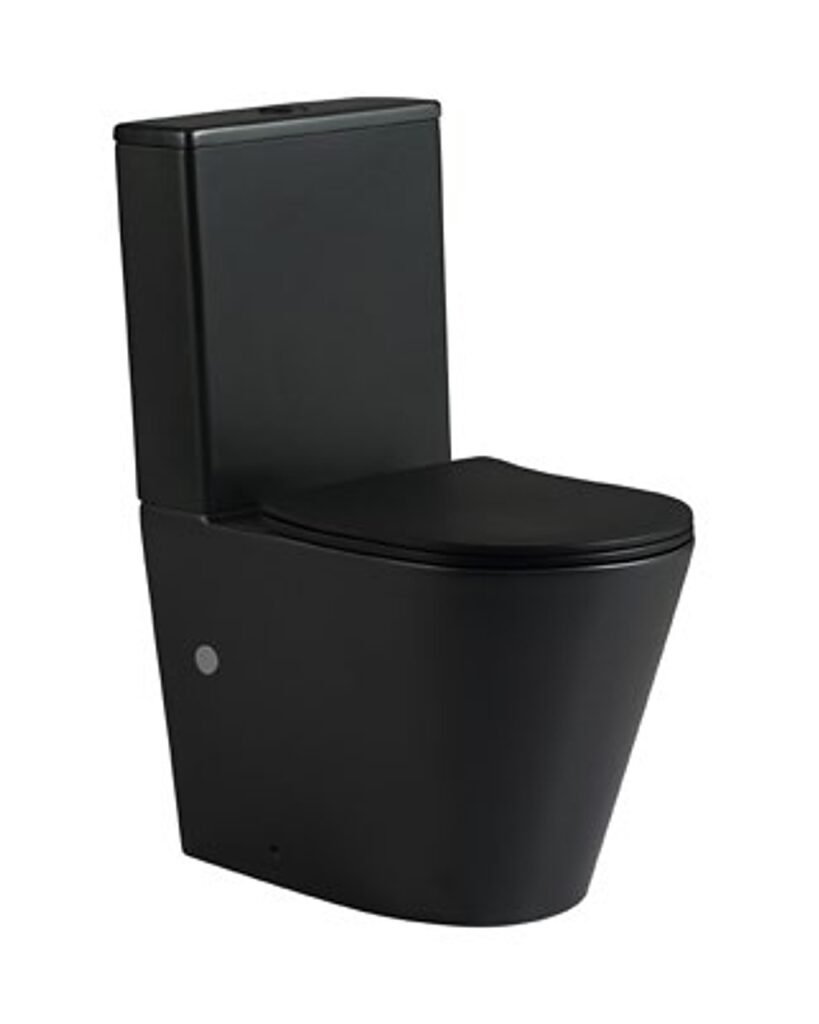
Colour on ceramic is chemistry, not coating
A painted surface sits on top of what it covers. A glazed ceramic surface is fused into it. The colour on a toilet pan is produced by glaze materials that are applied to the body and then fired, so the finished surface is the product of a chemical process rather than a coat of pigment.
That single difference explains almost every difficulty buyers meet on coloured orders. Paint can be mixed to a reference at any moment. A fired glaze has to be judged after a thermal cycle has completed, on the production line that will make the order. A colour on ceramic is agreed as a target and then controlled as a process.
The process in four stages
Every coloured pan passes through the same four stages, and each one changes what the next stage can achieve.
- The body — cast or formed and dried, with its own colour and surface texture before anything is applied.
- The glaze — a suspension of minerals applied to the body, carrying whatever colouring materials the finish calls for.
- The firing — the body and glaze are brought to temperature together, and the glaze melts and bonds to the body.
- The colour — what the glaze finally reads as, which is decided by the chemistry and the cycle rather than by the glaze alone.
The fourth stage is the one buyers see and the one nobody can inspect until the kiln has done its work. Between the second stage and the fourth sits a thermal process, and that is where a colour can drift without anyone intending it to.
Why a swatch is not a batch
A physical swatch is a fired sample of a glaze on a small piece, produced at a particular time on particular equipment. It is a record of what the colour looked like once. It is not a specification of what the next run will look like, because the same glaze fired differently will not read the same.
This is why buyers who approve a swatch sometimes find that the delivered pieces read differently under their own lighting. There are three separate variables at work: the glaze as mixed, the firing as run, and the light the finished piece is judged under. A swatch controls none of the three on your behalf.
The honest version of a colour agreement is therefore a target plus a procedure for judging it, not a single reference. That is a weaker promise than a paint chip, and it is the strongest one a fired product can make.
What can be promised and what cannot
Separating the two is what makes a coloured order workable. A factory can commit to a process. It cannot commit to a colour being identical to a sample taken at another time, in another light, by another person.
- A process can be committed to: glaze controlled to a target, firing held to a cycle, inspection at an agreed station.
- A batch can be committed to: the pieces made in one run being consistent with each other, which matters most when they are installed together.
- A swatch cannot be committed to: an exact match to a sample fired at another time, and no honest supplier will say otherwise.
- Lighting cannot be settled in a document: the same piece reads differently in daylight, under warm interior light and under the light of a phone.
Where a project has to match ceramic against an existing installation, or against a tile that was bought years ago, the request is really a colour-matching project. Treat it as one, with samples from the actual production line, rather than as a catalogue choice.
What to fix in writing before a coloured order
Five items turn a colour discussion into a set of instructions that can be executed and, if needed, argued about on facts rather than impressions.
- The finish, named against the finish list for that specific model rather than against a general description.
- The sample used to agree the target, kept by both sides, with the caveat that it is a reference rather than a guarantee.
- How the finished pieces will be judged: the light, the viewing distance, the surface to be compared.
- The quantity per model, because coloured and matt finishes are quoted per model at a minimum of 30 pieces.
- Whether all the coloured pieces on the project come from one run, which is the only way to keep them consistent with each other.
The fourth item is where coloured orders most often go wrong commercially. Colour is a set-up property: a factory prepares a glaze for a model and runs it as one batch. Below the minimum the set-up is not workable, and above it the whole batch is made together, which is exactly what a project wants for consistency.
Quantities and finishes across a range
Where finishes are quoted per model, the practical rule is to plan by model rather than by order. An order covering several models at the minimum for each is not one coloured order; it is several coloured runs that happen to travel together.
It also means the finish list belongs to the model, not to the range. A finish offered on one body may not be offered on another, because the glaze and the shape have to suit each other and the set-up is planned per model. Ask which finishes a specific printed code is produced in before planning a scheme around it.
Questions to put to a factory about colour
Four questions separate a supplier who understands fired colour from one who is repeating a catalogue. They are short, and the answers are telling.
- Which finishes is this printed code produced in, and which of them are held as standard?
- Will the coloured pieces for this order be fired as one batch, so they are consistent with each other?
- Which sample will be kept by both sides as the agreed reference for the target?
- How will the finished pieces be judged, and under what light, if a question is raised on arrival?
A factory that answers all four is describing a process it controls. A factory that answers only the first is selling a colour name, and the rest will be settled by whoever opens the container.
What the buyer should send
Colour is a specification line like any other, and it belongs in the same place as the model code and the quantity. Sending a photograph of a desired finish is not a specification, because a photograph of a fired surface carries the light it was taken in, the camera that took it and the screen it is displayed on.
Send the model codes, the finish name for each, the quantity per model, the reference sample if one exists, and the destination market. With those five lines a factory can say what it can do, what it cannot, and where a sample needs to travel before anything is confirmed in writing.
Read colour as a controlled process rather than a fixed object. That changes what a buyer asks for: not a promise that the batch equals the swatch, but a clear statement of how the glaze is controlled, how the order will be run, and how the result will be judged.
Frequently asked questions
Is coloured ceramic glazed or painted?
Glazed. The colour comes from materials carried in the glaze, which is applied to the body and then fired so that the surface melts and bonds to it. Nothing sits on top of the finished surface as a coat, which is why the colour is part of the ceramic rather than a layer over it.
Can you match an exact colour from a sample?
A sample can be used as the agreed target, and we will say plainly what a fired glaze can and cannot promise. It cannot be promised to match a sample fired at another time under different conditions, because the same glaze fired differently reads differently. Agree the target and the way it will be judged.
Why do pieces from two runs look different?
Because the glaze and the firing both vary slightly between runs, and the finished colour follows both. That is why a project that needs consistent pieces should have them made together in one batch. Pieces fired in the same run hold together; pieces from separate runs may not.
What is the minimum for a coloured finish?
Coloured and matt finishes are quoted per model at a minimum of 30 pieces for that model. The figure is per model because colour is a set-up property: the glaze is prepared and run for the model being produced, so an order across several models is several runs rather than one.
Does the light in my showroom change the colour?
It changes how the colour reads, and it does so for any fired surface. A piece judged in daylight, under warm interior light and on a screen will appear three different ways. This is why the judging light and distance belong in the written agreement rather than being left to whoever opens the container.
Does colour change the ceramic body underneath?
No. The finish is applied over the body, and a coloured pan and a white pan of the same model share the same body specification. Every model in our range, across all 89 codes, uses a vitreous china body regardless of the finish applied to it.
Related on this site
Documents and certificates
Related reading
- Coloured glaze and metal trim at the per-model minimum
- What vitreous china describes
- Water Absorption and How a Body Is Classified