
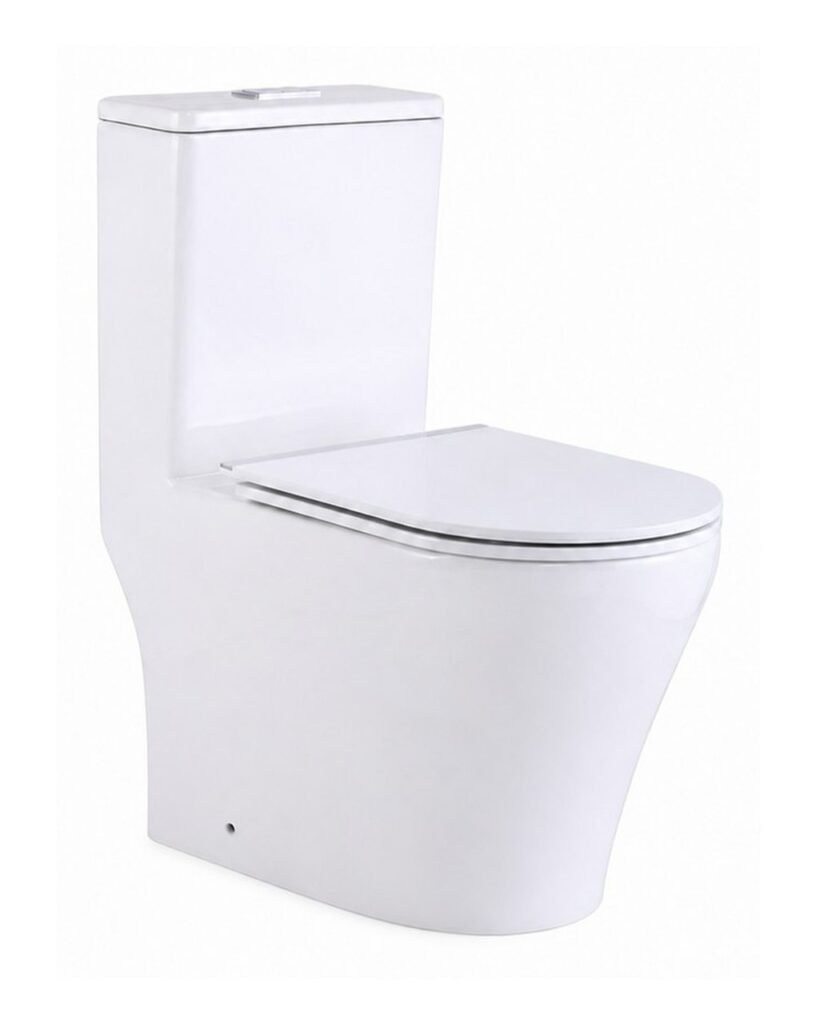
What “vitreous china” describes
In general industry usage, vitreous china describes the fired ceramic body used for WC pans, cisterns and bidets. The body is fired until it becomes vitrified — dense, closed and effectively non-absorbent — and the glaze is then applied over it. The term describes the body. It does not describe the finish, the shape, the mounting or the flush.
That distinction matters more in this category than in most. A toilet is a fixture that spends its life wet. A body that takes on water is a body that can stain, hold odour and change over time, and none of that is visible on the day the container is unpacked. Water absorption is one of the few body properties a buyer can actually ask for as a number, which is why it is the first document a serious specifier requests.
Why the body is the one thing a photograph cannot show
A photograph shows the glaze. The body sits behind it. Two pans can look identical in a catalogue — the same profile, the same white, the same photograph on the same background — and be made to different body specifications. This is the reason “ceramic toilet” is not a specification: it names the family, not the grade.
It also means the body has to be written down rather than described. “Premium ceramic” and “high-grade vitreous china” are not requirements; a body statement with a test report behind it is. If the requirement is the body, put the body on the page.
What we put in writing
Three statements, all verifiable, none of them inferred from a photograph.
- Every model in our range is vitreous china — all 89, across two-piece and one-piece WCs, wall-hung and back-to-wall pans, smart toilets, bidets and accessible suites.
- Bodies are fired in our own tunnel kiln at Chaozhou, with casting, glazing and firing under one roof. We have run our own ceramic production lines in Guangdong since 2021; the plant covers 51,000 m² and employs 285 people across casting, glazing, firing, QC and export.
- The water absorption test report is published rather than held back, and ceramic bodies carry a lifetime warranty.
The AS 1976 figure: 0.14% water absorption
Our published AS 1976 test report records water absorption of 0.14%. It is open access on our downloads page — no login, no form — because a number that has to be requested is a number nobody uses.
Read it as what it is. It is one test report, on the sample that was tested, by the testing house named on the report. It is not a promise about every firing, and it is not a market approval. If your market’s route to approval needs an absorption result for the specific model you are importing, ask for it against that model and that market: we will send the matching file, and say plainly if it is not available yet. Where a project is concerned with what the fixture emits rather than what it absorbs, we also publish SGS VOC test reports for two of the models in the range.
What the body does not decide
A vitreous china body answers exactly one question. Everything else a project has to specify sits outside it, and each is recorded per model rather than per range:
- Mounting — floor-standing, back-to-wall or wall-hung.
- Flush mechanism, which is a separate value from the body and, on some models, from the rim.
- The rim, which is recorded separately and is what a hygiene or cleaning clause is actually buying.
- Trap arrangement and rough-in, which decide whether the pan fits the building.
- Finish, chosen from the finishes that model is produced in.
- Market approval, which is a process tied to a model and a market — not a property of the ceramic.
The body is the floor of the specification, not the whole of it. A supplier who answers every question with “vitreous china” has answered one.
How to put the body into a request
Four lines, none of them an adjective. This is the version of a body requirement that a factory can answer with documents instead of reassurance.
- The body, named: vitreous china.
- The evidence your market expects — a water absorption report at minimum, and an emissions report where the market asks for one.
- The printed codes the answer has to cover, so the reply is about your order rather than about the catalogue.
- The destination market, because the document set that settles the question depends on where the goods are going.
Sent that way, the reply comes back as a list of file names, which is worth more than a paragraph about quality.
Frequently asked questions
Is vitreous china the same as ceramic?
In our range the two words work at different levels. Ceramic is the material family; vitreous china is the specific fired body. Industry usage is looser than that, and some suppliers use “ceramic” to cover bodies that are not vitrified — which is exactly why the body belongs on the specification rather than in the marketing line.
Why does water absorption matter on a toilet?
It is a measure of how dense and how closed the fired body is. A body that takes on water is exposed to moisture for the whole life of the fixture; a vitrified body is not. It is also one of the few body properties that can be evidenced with a test report rather than described with an adjective.
Do all of your models use vitreous china?
Yes — all 89 models in the range are vitreous china, across WCs, smart toilets, bidets and accessible suites. There is no second, lower body specification elsewhere in the catalogue.
Can I get the water absorption test report?
It is already public. The AS 1976 test report recording 0.14% water absorption downloads straight from our downloads page, together with the catalogues, the technical drawing set and the certificates we hold. If you need a report that is not there, tell us the model and the market.
Does the finish change what the body is made of?
No. The finish is applied over the body. A matt black pan and a white pan of the same model share the body specification, and models in the range are produced in different finishes without changing what sits underneath.
Does a vitreous china body mean the toilet is approved for my market?
No. Approval is a separate process, tied to a model and to a market — CE on the construction-products route into the EU, WaterMark in Australia, SASO and SABER in Saudi Arabia. The body is part of what gets tested; it is not the approval.
Related on this site
Documents behind the body
- The AS 1976 water absorption report, the catalogues and the drawings
- Certificates and the markets they cover
- The kiln, the plant and the QC record
Models across the body range
- 6093 LUZZI — two-piece, four finishes
- 6003 X-CUBE — two-piece, three finishes
- 6079A — fully skirted one-piece
- 2303 X-CUBE — wall-hung pan
- SMART-1 — integrated smart toilet
- 1303 X-CUBE 55 — floor-standing bidet