
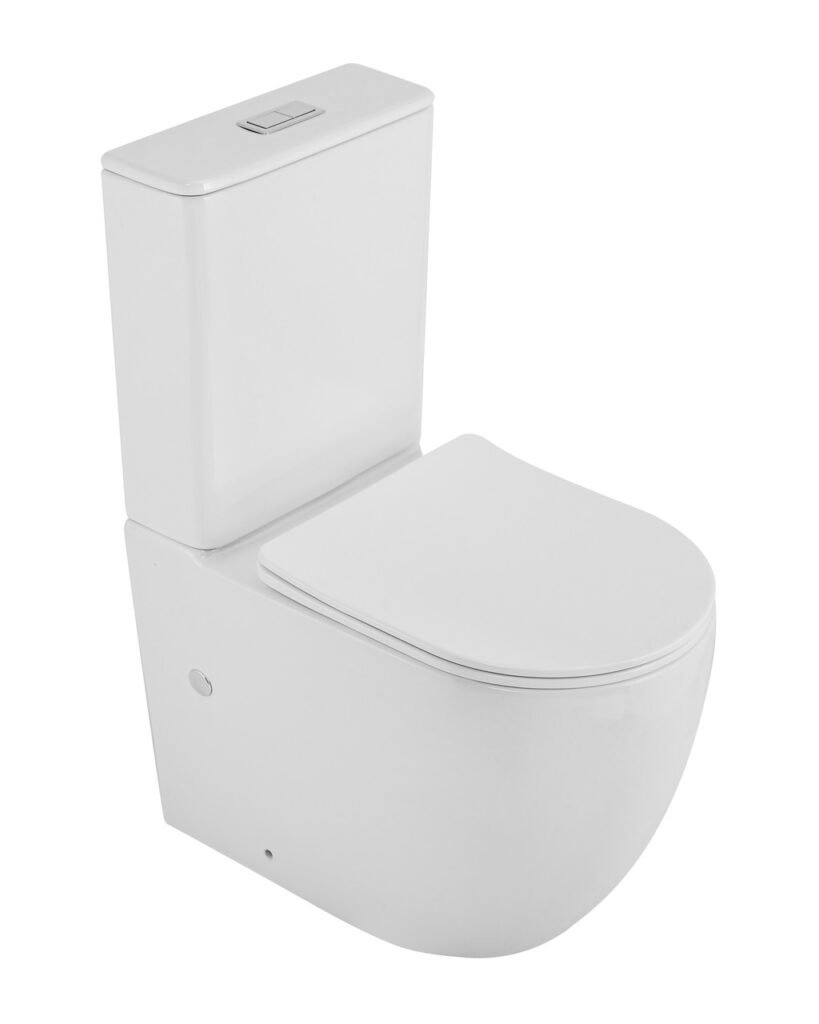
The flush line carries three different things
On a WC specification sheet the flush line looks like a single attribute. Ours carries three different kinds of information on that one line, and reading it as one thing is how buyers end up comparing models that were never comparable.
- The flush mechanism: wash-down, tornado wash-down, or single-hole tornado whirlpool wash-down.
- The rim: recorded as “Rimless flush” on 23 of our models.
- The actuation: the dual-flush variants, which describe how the user releases the water rather than how the water moves.
They sit on the same line because they come out of the same field in our catalogue data. They are not the same decision, and each of the three has to be confirmed for the model you are buying.
The flush mechanisms
In general industry usage, a wash-down flush releases water from the flush inlet and carries the bowl contents down into the trapway. Tornado and whirlpool naming is used for designs where the flow is directed so that it travels around the bowl rather than dropping straight through — the two words are used by different manufacturers for related swirling designs, and the exact geometry behind either name is a factory detail that the name itself does not settle.
What we can state about our own range is narrower and more useful. Across the 89 models, our catalogue records wash-down on 52, tornado on 43 and whirlpool on 28. Those figures overlap: a whirlpool model’s flush value names both whirlpool and wash-down, and the tornado figure therefore includes all 28 of them. The three counts also exclude the 23 rimless models, for the reason set out in the next section — on those models the flush value is a rim description, not a mechanism statement.
Tornado is the system our factory is built around: the company describes it as engineered for strong, quiet performance, and the smart range records it on eleven of its twelve models.
- Tornado wash-down, recorded on four models including 6083 VOGHERA, 6088 FEANZA and 6092 ZENITTI.
- Single-hole tornado whirlpool wash-down, recorded on twenty-eight models, including 6003A, 6080A, 6081A and 6099A.
- Wash-down, recorded on six models including 6009F MASSA-S, 6009CA MASSA-P and 6018.
The rim is not a mechanism
“Rimless flush” appears on the same line as the mechanisms, but it describes the rim rather than the flush. A rimless pan removes the boxed rim and the enclosed channel underneath it; it says nothing about how the water is delivered.
On the 23 models where that value is recorded, the flush line is a rim description and not a mechanism statement — the two come from the same field in our catalogue data, so the rim value takes the place of the mechanism value rather than sitting alongside it. Where a project has to name the mechanism as well as the rim, put both on the request: we confirm the mechanism against the model in writing.
If you are specifying hygiene or housekeeping clauses, the rim is the attribute you are buying. If you are specifying flush behaviour, it is not — and treating “rimless flush” as the name of a flush system is one of the more common misreadings of our sheets.
Dual flush is an actuation, not a mechanism
The dual-flush models are recorded separately, because dual flush describes how the user releases the water: two settings instead of one, operated from push buttons in the cistern lid or from a wall plate. It does not describe the flush path, and it does not describe the rim. Ten of our models carry it, and they are split across two-piece, one-piece, wall-hung and back-to-wall bodies — which is again the proof that actuation and mechanism are separate decisions.
What a flush name cannot promise
A flush name is a description, not a rating. It does not promise a water volume, a flush score, a noise figure or a market approval. Where a project has to demonstrate performance, the evidence comes from the model’s documents and from the approval process for that market, not from the words on the product page.
It also does not survive comparison across suppliers. One factory’s tornado is not another factory’s tornado, and a buyer who specifies “tornado flush” without naming a model has written a requirement that cannot be quoted against.
How to write the flush requirement into an RFQ
- The model, by printed code — a flush name alone is not a specification.
- The flush value exactly as your project wrote it, so the difference can be identified rather than argued about.
- The rim requirement, stated separately, if the project has a hygiene or cleaning clause.
- The actuation, stated separately, if the project fixes the number of flush settings.
- Any performance evidence required for the market, asked for as a document rather than as a flush name.
Frequently asked questions
Which flush type is strongest?
We do not publish flush-performance comparisons, so we will not rank our own systems for you. Tornado is the system the factory is built around and the one used across the smart range; if a project needs a performance claim, the answer has to come from the model’s documents and from the approval your market requires.
Is rimless a flush system?
No. Rimless describes the rim. It appears on our flush line because rim and mechanism come from the same field in our catalogue data, so where a rim value is recorded it takes the place of a mechanism value. If the mechanism has to be named as well, ask for it against the model and we will confirm it in writing.
Is dual flush a different flush system?
No. Dual flush is a control arrangement: the cistern releases one of two volumes on demand, from buttons in the lid or a wall plate. The flush mechanism and the rim are separate attributes, confirmed per model.
Can I choose the flush system for a model?
The flush is a property of the model, not an option that can be swapped on request. Where a model is recorded with more than one arrangement, it is stated on its own page. If your project fixes a flush value, send it with the requirement and we will name the models that carry it.
How do I compare two models that both say “tornado”?
Compare the models, not the word. Take the printed sizes, the mounting, the trap and the rough-in from the technical drawing set and put them side by side; the flush name will be identical because it comes from the same factory, so it cannot be the tiebreaker.
Where is the flush value for a specific model recorded?
On the model’s own page, and in the catalogue the printed code refers to. Our downloads page carries the catalogue and the technical drawing set in the open, with no login and no form.
Related on this site
Tornado wash-down models
Single-hole tornado whirlpool models
- 6003A — single-hole tornado whirlpool wash-down
- 6080A — single-hole tornado whirlpool wash-down
- 6099A — single-hole tornado whirlpool wash-down
Wash-down and dual-flush models
Range, documents and terms
- The whole range, 89 models
- Catalogues and technical drawings, open access
- Dual flush: how the two volumes work
- Rimless: what the open rim changes
- Send the flush value you need — we will name the models