
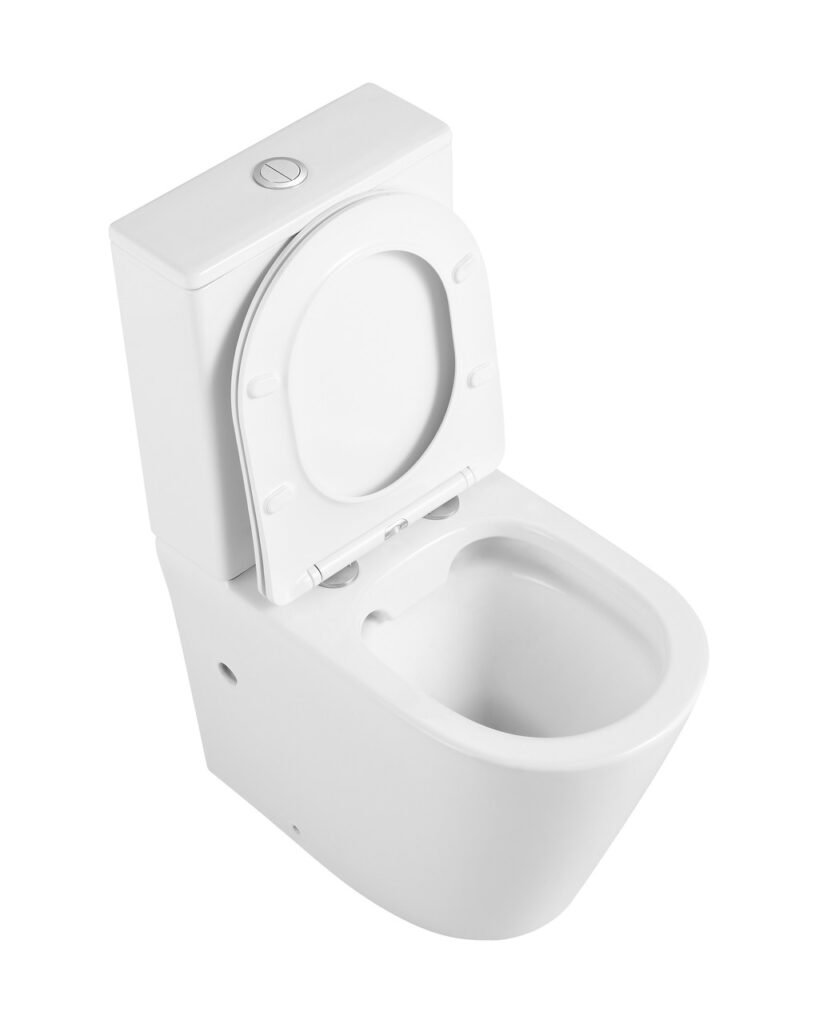
The joint nobody sees, and why it fails first
When a ceiling below a bathroom stains, the first suspect is the pan, and the second is the cistern. In most cases the fault is neither: it is the joint where the pan outlet meets the soil pipe, a connection buried under the base and never looked at again after the day it was made. That joint has to do three separate jobs at once, and it is asked to do them for the life of the building without maintenance.
The three jobs are simple to state. It has to keep soil gas out of the room. It has to keep water in the pipe when the pan is flushed and when it is not. And it has to let the pan sit down on the floor, because a pan held off the ground by its own connection will rock, and a rocking pan works the joint loose. Any discussion of wax, rubber or a flexible connector is really a discussion of which of those three jobs a given material does best on a given floor.
Three conditions make the outlet connection the weakest point in the installation. It is hidden, so a small failure is discovered late and from below. It is the one joint that carries movement, because every load on the pan passes through the base and into the floor around it. And it is made between two different materials — ceramic and plastic or cast iron — with a sealant that has to bond to both while staying flexible enough to absorb that movement.
There is also a design tension that no material removes. The seal has to be compressed to work, and compressing it pushes the pan up. The installer resolves that by tightening the pan down onto the floor, which is correct only if the seal compresses into its own recess rather than holding the base off the tiles. That is why the choice of seal and the flatness of the floor cannot be decided separately.
Wax: what it suits
A wax seal works by being squeezed into the gap and staying there. It has no memory and no mechanical parts, it does not perish in the way rubber does, and it tolerates the slightly irregular surfaces found on older pipework. On a rigid floor with a pan that will never be moved, it is the simplest and most forgiving option — which is why it has survived so long in markets that install in cast iron and heavy pipe.
What it does not tolerate is being disturbed. A wax ring compresses once; lift the pan after the seal has been made and the ring has to be replaced, not re-set. It also behaves differently across temperature: very cold wax is stiff and does not flow into a gap, and a floor that moves seasonally will eventually break the seal rather than flex with it. On a refurbishment where the pan may come up again, that single-use property is the whole argument against it.
Moulded and rubber seals: what they suit
A moulded seal — a rubber or elastomer ring, a sleeve with a lip, or a shaped gasket that seats into the pan outlet — works by elastic compression rather than by flow. It can be removed and re-fitted, it absorbs small movements instead of cracking, and it does not care much about ambient temperature. On a tiled floor over a modern plastic pipe it is usually the easier joint to make correctly, because the seal locates positively instead of relying on the installer’s judgement about how much wax to use.
Its weakness is tolerance. These seals are made for a specific spigot and a specific pipe size, and they need the pipe cut square and clean, with the correct depth of engagement. A burr on the pipe, a pipe cut at an angle, or a seal pushed in only part way will hold for a while and then weep. It is a joint that rewards preparation and punishes speed.
Flexible connectors: what they solve, and what they cost
A flexible connector exists to solve a geometry problem. Where the soil pipe does not line up with the pan outlet — a renovation where the old pipe sits off-centre, a floor build-up that moved the outlet, a replacement pan with a different trapway — a short flexible sleeve bridges the offset without moving the pipe. In those situations it is not a shortcut; it is the only workable answer short of breaking the floor.
It has two costs that should be stated plainly. The first is space: a flexible connector needs room under the base, and if that room is not there it holds the pan up, which produces exactly the rocking complaint that gets blamed on the ceramic. The second is support: a flexible sleeve that carries the weight of the pan will deform over time, so the pan must bear on the floor and the connector must carry nothing but the seal. Where neither condition can be met, the pipe should be moved instead.
The floor condition that decides the choice
Before any of the three is selected, the floor has to be understood. A rigid, flat, fully supported floor — screed or a solid substrate, finished level — allows any of them. A timber floor with deflection, or a floor with a recess around the outlet, narrows the field quickly, because the seal must accommodate movement the pan will transmit. A floor that falls away towards the outlet leaves the connection carrying load it should not carry.
The questions to settle on site are therefore about the floor, not about the seal: is it flat under the base, is the pipe fixed and square to the floor, is the outlet recess deep enough for the connection chosen, and will the pan bear on the tiles rather than on the pipe. The answers decide the material. Buying the seal first and finding out afterwards is how the connection ends up holding the pan in the air.
The three connections, side by side
The drawing below puts the three options in the same section, so the difference in how each one fills the gap is visible.
Read across the three panels and the trade-offs are visible without a text. The wax ring fills the gap by compression and has nothing to locate it. The moulded seal sits on a lip and locates itself. The flexible connector spans a distance, which is useful where the pipe is offset and a liability where the pan needs to bear on the floor. In all three, the pan outlet is the constant and the pipe is the fixed point; what changes is how much tolerance each option can absorb.
Order of work, and the cost of doing it twice
The most useful rule about this joint is about sequence. Set the pan dry, on the floor, with the seal in place but nothing tightened, and confirm two things before anything is made permanent: that the pan sits on the floor all round, and that the outlet engages to the depth the seal needs. Only then make the joint good and fix the pan down.
The reason is the rework cost, not the part cost. Redoing this joint means lifting a pan that is already sealed and fixed, which risks the ceramic, the floor finish and the waterproofing membrane in a wet area. A wax ring is destroyed by the lift and has to be replaced. That asymmetry — a cheap component and an expensive correction — is what should drive the specification, and it is why a five-minute dry fit is worth more than a faster installation.
What we do and do not supply
Our scope is the ceramic. The body, the glaze, the trapway and the outlet spigot are ours, and the outlet is formed and inspected with the rest of the piece — all 89 models in the range are vitreous china, fired in our own tunnel kiln at Chaozhou, with casting, glazing, firing and QC in the same plant.
The seal, the connector and the fixings are not ours, and we do not supply them; they are chosen by the installer or the buyer against the pipe and the floor actually on site. What we can do is tell you what the pan outlet is, so the seal can be matched to it: the drawing set records the outlet geometry for each model, and the batch record ties a delivered pan back to the run that made it. Ask for the drawing rather than assuming the outlet matches the last model you bought — that assumption is behind a good share of the leaks this joint produces.
Frequently asked questions
Is wax better than a rubber connector?
Neither is better in the abstract. Wax suits a rigid, flat floor and a pan that will not be lifted again. A moulded seal suits a floor with slight movement and an installation that may need to be reopened. The floor and the pipe decide, not the material’s reputation.
Can a wax ring be reused after the pan is lifted?
No. A wax seal compresses once and does not recover its shape. Once the pan has been lifted, the ring has to be replaced before the pan goes back down. Reusing it is one of the common causes of a smell that appears weeks after a repair.
Why does the bathroom smell at the pan?
Usually because the outlet joint is not sealed, so soil gas reaches the room around the spigot rather than through the trap. The pan is rarely the cause. Check the joint, the engagement depth and whether the pan is bearing on the floor or hanging on the connection.
Does the pan have to come out to change the seal?
Yes. The joint is under the base, so the pan has to be lifted clear to reach it. That is the practical reason to get the connection right the first time, and the reason the choice of seal should be made before the pan is fixed down.
Do you supply the seal or the connector?
No. We make and supply the ceramic body; the seal, the connector and the fixings are sourced by the installer or the buyer to suit the pipe and floor on site. We will confirm the outlet geometry of the model so the right seal can be selected.
What should be checked on the floor first?
That it is flat under the base, that the soil pipe is fixed and cut square to the floor, and that there is enough recess for the connection chosen. If those three are not right, no seal will hold, and the pan will end up standing on its own connection.