
The question usually arrives at the wrong moment
In most projects the VOC question is asked after the sample has been approved. The buyer has seen the pan, signed off the finish, and then a consultant or a client asks for emissions documentation. By that point the specification is closed, the model is chosen, and the only remaining moves are to produce a document quickly or to change the product.
It is a sequencing problem rather than a technical one. VOC documentation is one of the few items in a sanitary ware file that can be checked in parallel with everything else, because it does not depend on the order, the quantity or the delivery date. Asking for it at enquiry stage costs a paragraph in an email. Asking for it after approval costs a decision.
What a VOC report covers
A volatile organic compound report is a test result, and like every test result it is bounded by four things: the sample, the materials, the method and the conditions. The report says which sample was tested, which materials or coatings on that sample were assessed, which method was used, and what the result was against the criteria of that method.
Those four boundaries are the whole document. If the sample was a white pan from one model, the report is about that pan. If the assessment covered the glaze and the body, it is about the glaze and the body. If it covered the glaze alone, then the rest of the article is outside the report, whatever else the article contains.
None of that weakens the document. It defines it, which is the same thing a drawing does when it states a scale and a projection. A document with a boundary can be relied on inside the boundary. A document without one cannot be relied on at all, because there is nothing to check.
What it does not cover
This is the part buyers most often assume and least often read.
- It is not a statement that the product complies with the requirements of your market. That is a certification question, answered by a certification document.
- It is not a statement about models that were not tested, even where those models are made from the same body and the same glaze.
- It does not cover materials applied on site: adhesives, sealants, grouts and silicones that are chosen by the installer belong to the installer’s own documentation.
- It does not cover what happens to the product over years of use, cleaning agents included.
Each of those is a different question with a different owner. The emissions test answers what the tested article emits under the test conditions, and it answers nothing beyond that.
Why a ceramic fixture makes the question narrower
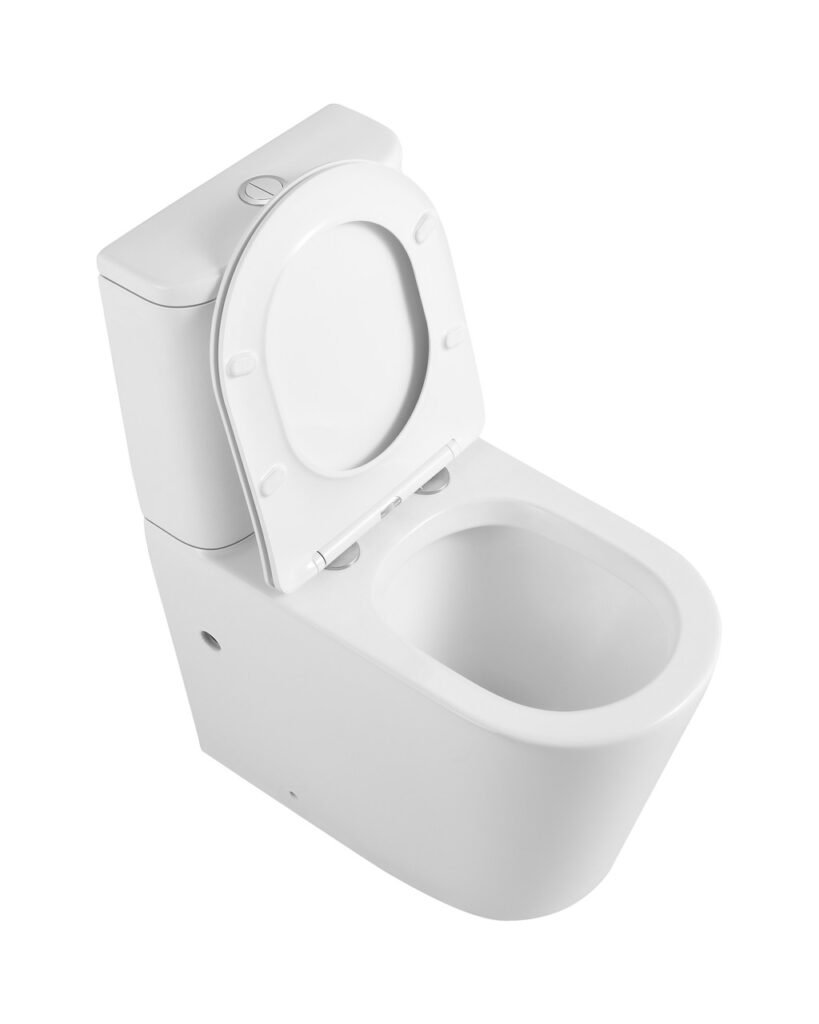
A toilet is mostly a fired ceramic body with a glaze over it, plus a seat, a flush mechanism and a set of fittings. The fired body has been through a kiln, which is why the body itself is rarely the interesting part of an emissions conversation. The glaze, the applied finishes and the components are where the question usually lands, and each of those has its own supply chain.
The consequence for a buyer is that a single report may cover less of the finished article than expected. An emissions assessment of a glaze does not speak for a seat, a hinge or a flush valve. If the specification covers the whole fixture, the document set has to as well, and that is a question worth asking before approval rather than after.
This is also where coloured and matt finishes deserve a mention. A finish is an additional material, and additional materials are additional questions. Our coloured and matt finishes carry a minimum of 30 pieces per model, which is a commercial fact; the emissions question about those finishes is a technical one, and it is answered per finish rather than per range.
Where the report sits in a file
Think of a product file as a chain rather than a stack. A material declaration says what the article is made of. A VOC test says what the tested sample emits. A product certificate says the article has been assessed against a standard for a market. Market access is the outcome the other three support.
No link in that chain implies the next one. A material declaration does not imply a test, a test does not imply a certificate, and a certificate does not imply that a project will accept the product. When a buyer treats the chain as a stack, the first document that arrives gets credited with work the others were supposed to do, and the gap is discovered by a reviewer.
The two reports we hold
We hold two SGS VOC test reports. They are published on our downloads page, together with the AS 1976 test report recording water absorption of 0.14% and the technical drawing set, and they are there because a buyer should be able to read them without asking permission.
Two reports is not a range. If your project needs emissions documentation for a model that is not one of the two, the answer is that we will check what exists, and if nothing exists we will say so. We will not describe a report on one model as covering another, and we will not quote a limit value that belongs to a standard we have not tested against. Limits are set by the method and by the market, and quoting one without the other is how a technical document becomes a marketing claim.
What to request, and when
Ask at enquiry stage, and ask in a way that produces a useful answer.
- The model codes, so the answer is per model rather than per range.
- The materials the report has to cover — body, glaze, applied finish, seat, fittings — because a report that covers the glaze answers a narrower question than one that covers the fixture.
- The standard or scheme your project applies, since the acceptance criteria come from there rather than from the supplier.
- Whether the requirement is a test report, a declaration, or both, because those are three different documents.
Sent that way, the reply tells you what exists and what does not, and you can make the specification decision while there is still time to make it. Sent as “do you have VOC reports”, the reply is likely to be a link, and a link is not a scope.
The sentence to keep
A VOC report is evidence about a sample under a method. It is not compliance, and it does not stand in for a certificate. Hold it as one link in a chain, ask for it early, and read the sample description before the result.
Frequently asked questions
What does a VOC report actually test?
It tests emissions from a sample, under the conditions of a specific method, for the materials the report names. The sample, the materials, the method and the result are the document. Anything not named in those four is outside it, whatever else the product contains.
Is a VOC report the same as product certification?
No. A VOC report records a test result on a sample. Product certification is a separate assessment against a standard for a market, carried out through a certification route. One does not stand in for the other, and a file needs whichever of the two the market actually requires.
Do you have VOC reports for every model?
We hold two SGS VOC reports, published on the downloads page. That is not a range-wide claim. If your project needs documentation for a model outside those two, send the code and we will confirm what exists, and say plainly if nothing does.
When should I ask for emissions documentation?
At enquiry stage, alongside the certificate and drawing requests. Asking after the sample is approved leaves you with a document problem and no room to change the model. The request costs one paragraph before the order and a decision afterwards.
Does the report cover the seat and the fittings?
Only if the report says so. Seats, hinges and flush components are separate articles with their own materials, and a report on a glaze or a body does not speak for them. If the specification covers the whole fixture, check which parts the report names before relying on it.
Can you tell me the emission limit my market allows?
Limits belong to the method and to the market’s rules, not to the supplier, and they change. We will tell you what our reports record and which method was used. The applicable limit should be confirmed against the current official guidance for your market before it is written into a specification.
Related on this site
Documents and certificates
- The SGS VOC reports, the AS 1976 report and drawings
- Certificates and the markets each one covers
- Ask for documentation on a named model