
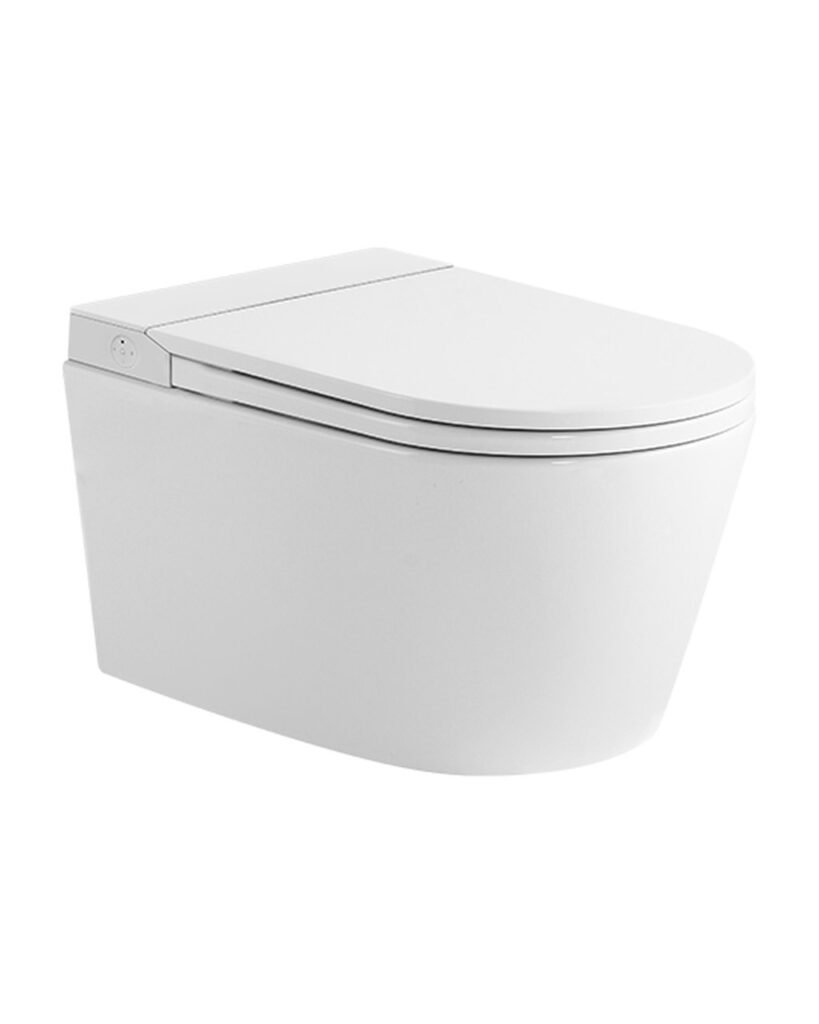
Ceramic fails once; electronics fail in parts
A ceramic pan has one failure mode that matters and it is usually decided in the first week: it arrives broken, or it does not. After that it is a fired body doing nothing, and it will keep doing nothing for a very long time. That is why a lifetime warranty on the body is a reasonable promise to make.
A smart toilet behaves differently. It is a ceramic fixture with a mechanism inside it, and the mechanism has moving parts, a control board, a valve group and connections between them. Those do not fail all at once. They fail one at a time, in a unit that is installed, connected and being used, which means every failure is a service visit rather than a replacement.
This changes the question a buyer has to ask. For ceramic, the question is “what happens if it arrives broken”. For smart, it is “what happens in year two when one function stops working and the fixture is otherwise fine”. The answer is a spare parts strategy, and it has to be decided before the order rather than after the fault.
We do not publish electrical specifications for the smart range while those values are still being confirmed with the factory, so this article contains none. What it contains is the set of questions to put to any supplier — including us — and the terms that make the answers usable.
Sort the parts by who can change them
The useful way to organise a spares list is not by component type. It is by who is capable of replacing the item, because that determines where the stock has to be and what the service cost looks like.
Field-replaceable. Items a competent plumber or a trained merchant technician can swap with ordinary tools, without opening anything sealed and without calibrating afterwards. Seats and hinges, covers, flush plates and buttons, supply connectors, filters that are designed to be removed. These are the items that should never cause a return, and they are the ones to stock first.
Service kit. Items that can be replaced on site but need a procedure, a specific part set, or a person who has been shown how. Valve groups and inlet assemblies typically sit here, and so do sub-assemblies that have to be matched to the unit they came from. These require a trained partner rather than any plumber, which means the training is part of the spare parts programme, not a separate courtesy.
Return to factory. Anything that needs diagnosis, a sealed assembly that cannot be opened in the field, or a board that has to be matched and tested. The right answer here is not “ship it back and see” — it is a defined process with an authorisation step, so the unit does not travel twice.
Ask a supplier to place every part in one of those three tiers, in writing, before the first order. A list that has everything in the top tier is not credible. A list that has everything in the bottom tier is a warning about the cost of ownership.
Batch compatibility: the question nobody asks first
Ceramic parts from different firings fit each other, because the shape is fixed by a mould. Electronic and mechanical assemblies do not work that way. A control board, a valve group or a connector can be revised between production runs, and a revised part may not be interchangeable with the one it replaced — or may be interchangeable in one direction only.
This matters most to the buyer with an installed base. A hotel with a hundred units from three different production runs does not have one product; it has three, and the technician at the desk needs to know which is which before opening a panel.
So the questions are concrete. Is there a revision register for the assemblies, and can it be shared? Does the unit carry a batch or serial code, and where? When an assembly is revised, is the new version backward-compatible with units already supplied, and is the old version still available for a period? If a customer needs a replacement for a unit supplied earlier, how is the correct version identified?
None of those answers require disclosing how the product works internally, which is why they are reasonable to ask. They require a supplier to know its own build history, which is a different test and a more revealing one.
Spare supply is a term, not a favour
Every factory will say that spare parts are available. Very few put the arrangement in the contract, and the difference only becomes visible when a part is needed.
Four things have to be written. Which parts are covered, by name or number. Who holds stock, and at what level relative to the installed base. How a replenishment order is placed, and what the minimum quantity is. And what happens after a model is discontinued — how long parts remain available and through which channel.
Notice that none of those are day counts. A supply interval is a commercial term between the parties, and printing a number in an article would be inventing one. What a buyer should insist on is that the term exists, is measurable, and has a stated consequence if it is not met — the same standard as any other supply obligation.
There is a practical test that costs nothing. Before the first order, ask for the part numbers of the five items most likely to be replaced, and ask for a quotation for each. If the supplier can produce a number and a reference, the spares system is real. If the answer is a photograph and a promise, it is not yet a system.
Degraded operation: what happens when power or water stops
A smart fixture has to remain usable when the conditions it depends on are missing. Power cuts happen. Water is shut off for maintenance. A building’s supply pressure varies. The question is what the fixture does in those conditions, and whether the answer is acceptable to the people using it.
Three behaviours need to be established for any model, and they are questions rather than specifications: is there a way to flush without mains power, what happens to the functions that depend on water when the supply is off, and what the unit does when it returns to normal — does it resume, or does it need to be reset by hand?
For a hotel these are not technical curiosities. A room that cannot be flushed during a power cut has to be taken out of service, and the cost of that is measured in rooms rather than in parts. For a residential buyer the tolerance may be higher, but the question still has an answer and the answer should be known before installation rather than discovered during a failure.
Ask for the behaviour to be described in the operating instructions, in plain language, without reference to internal components. If it cannot be described that simply, the service partner will not be able to explain it to an end user either.
What to hold before the first installation
A spares holding is a decision about risk and cash, and it belongs with the party that carries the service obligation. What can be said without inventing numbers is what the holding should contain and how it should be sized.
Size it from the installed base, not from the container. The container is a purchasing unit; the installed base is a service population. A buyer installing a hundred units in one building needs a different holding from a merchant spreading the same hundred across a region, because the merchant cannot reach every unit quickly.
Include a commissioning allowance — a small set of the items most likely to be needed during installation itself, when damage and missing components are most common. Include the items that stop the fixture working entirely, because those are the ones that generate an urgent call. And include the consumables that a service partner will otherwise improvise.
Review the holding against actual usage after the first service season. A list built from a catalogue will be wrong in both directions: it will include parts that never fail and omit the one that fails repeatedly. The only reliable input is the record of what was actually replaced.
Documentation, labelling and training
The last part of a spares programme is the least expensive and the most often missing: the paper that lets somebody order the right part.
Three documents do the work. An exploded diagram of the serviceable assemblies, with part numbers against each item. A compatibility note stating which versions fit which production batches. And a short procedure for each field-replaceable and service-kit item, written for a technician rather than for an engineer.
Labelling belongs with them. If the unit carries a batch or serial code in a place that can be read without removing the fixture, a service call can be prepared before anybody arrives. If the code is on the carton only, the carton is in a bin and the information is gone.
Training is the final link, and it is a commercial item like any other. Who trains the service partner, how many people, whether it happens at the factory or on site, and whether the training is refreshed when an assembly is revised. A spare parts stock without a trained person to fit it is inventory, not service.
Put together, the programme is unglamorous: a list, a tier for each item, a stock position, a revision register and a diagram. It is also the difference between selling a smart fixture once and selling it into a market for years.
Frequently asked questions
Why does a smart toilet need a different spares plan?
Because its failure modes are different. A ceramic body either arrives sound or does not, and then lasts. A mechanism inside it fails part by part, in an installed unit, which turns every fault into a service visit. The plan has to exist before the first order, not after the first call.
Which parts should a distributor hold in stock?
Start with the field-replaceable tier — seats, covers, plates, connectors, serviceable filters — and add the items that stop the fixture working entirely. Size the holding from the installed base rather than from the container, and revise it after the first service season using actual replacement records.
Can parts from a later production run be fitted to an earlier unit?
Not always, and the answer has to come from the factory’s revision register rather than from assumption. Assemblies can be revised between runs, and interchangeability may run in one direction only. Ask for the register and for a batch code on the unit so the correct version can be identified.
What happens to a smart toilet during a power cut?
That is a question for each model, and it should be answered in the operating instructions in plain language: whether the fixture can be flushed without mains power, what happens to water-dependent functions, and whether it resumes by itself afterwards. For a hotel the answer affects whether a room stays in service.
Do you publish electrical specifications for the smart range?
Not yet. Those values are still being confirmed with the factory, and we would rather send nothing than send a number that later changes. When they are confirmed they will be published against each model, and any buyer can ask for the current position on the model they are considering.
How long are parts available after a model is discontinued?
That is a term to agree in the supply contract rather than a figure to quote in an article. What matters is that the contract states a period, names the channel, and sets a consequence if the obligation is missed. A verbal assurance is not a spares policy.
Related on this site
Documents and certificates
- Ask which parts are field-replaceable and who holds them
- Drawings, catalogues and the published test reports