
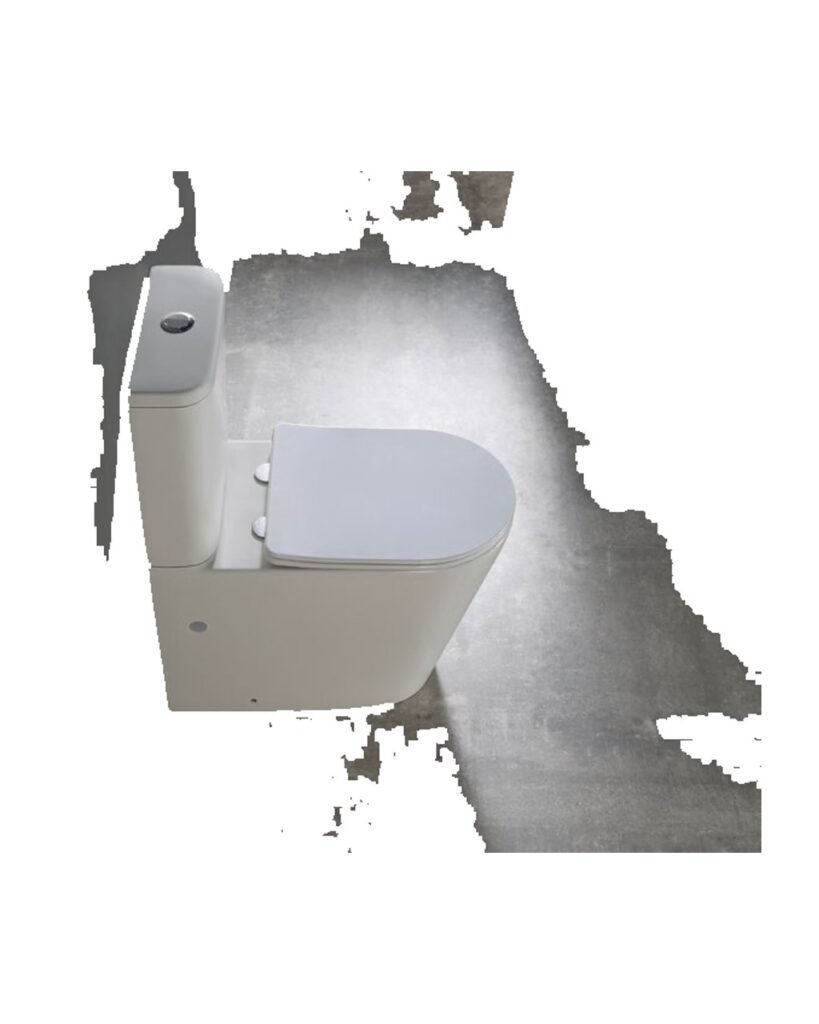
The seat is a specification of its own
A toilet seat and its hinges are not part of the ceramic body. They are separate components, made to their own drawings, and on many orders they are bought separately from the pan. Treating them as an accessory that comes with the fixture is how projects end up with a set that does not fit what was installed.
The reason is simple. The pan is a fired ceramic shape produced to a tolerance, and the seat has to sit on it. Two manufactured parts meeting at a seating face means two sets of dimensions and two sets of fixings, and unless somebody writes down how they meet, the match is left to chance.
Treat the seat as a specification line in the same way as the trap or the finish. It should appear in the order with a model reference, a material, a fixing pattern and a quantity, and it should be answered with the same kind of document as any other line.
What the seat has to match on the pan
Five things have to agree between the pan and the seat. Four of them are measurable, and one is a matter of how the finished product reads in use.
- The seating face — the outline the seat rests on, which follows the rim the pan was made with.
- The fixing holes — their position and spacing, which are decided by the mould and cannot be adjusted on site.
- The hinge mounting type — whether the hinges sit through the pan, onto the pan, or on a bracket.
- The overall footprint — how far the seat extends beyond the pan, which affects how the fixture reads in a room.
- The seating shape the project expects, which is a specification of its own rather than a consequence of the pan’s outline.
Where a project is ordering pans and seats from the same source, all five can be settled once and applied across the order. Where they come from different sources, the figures at the seating face and the fixing holes have to be exchanged in writing, because that is where two suppliers meet.
Materials, and what each one costs you
Seats are made in a small number of material families, and the differences that matter are practical rather than decorative. Each family trades something off against something else, and the right choice depends on how the fixture will be used.
- A thermoset seat is rigid and holds its shape, which suits a project where the seat must stay flat against the pan.
- A thermoplastic seat is more tolerant of handling and more likely to flex, which suits installations where movement is expected.
- A coated or painted surface changes the appearance and adds a finish to look after, and it is a separate line in the specification.
- Hinge material matters as much as the seat material, because the hinges carry the repeated movement rather than the seat itself.
The practical point is that a seat specification should name the material of both the seat and the hinges. Naming only the seat leaves the moving parts, which are the parts that wear, described by nobody.
Identifying the hinge fixing pattern
Hinge fixings are where most mismatches occur, because the pattern is decided by the pan’s mould and is invisible in a catalogue photograph. Before ordering seats, establish which pattern the pan uses and write that down beside the model code.
- Hinges fixed from above, into a seating face that has fixings cast into it.
- Hinges fixed from below, where the fixing is approached from underneath the pan.
- Hinges mounted on a bracket or plate supplied as part of the set rather than cast into the pan.
- Hinges that are integrated with the seat as a single item, so seat and hinge are replaced together.
Access differs between these patterns as well. A hinge that is fixed from below is quick to install before the pan is in place and awkward afterwards, which matters on a refurbishment where an old pan is staying and only the seat is being changed.
Closing and comfort features: how to specify them
Some projects ask for seats and hinges with particular handling characteristics, such as a seat that does not drop under its own weight, or a hinge that holds the seat at a chosen angle. These are specification items, and the way to handle them is to write down what the finished product must do and let the seat supplier confirm what it can provide.
That is the correct order of events. A requirement is stated, the supplier answers against it, and the answer becomes a line on the order. Asserting such a feature without a document behind it turns a requirement into an assumption, and an assumption about a moving part is exactly the kind of thing that becomes a claim when a container arrives.
Write these requirements as behaviour rather than as a product name: how the seat should move, what it should do when released, what force should be needed to operate it, and whether any accessibility standard applies. Behaviour can be confirmed, supplied and inspected. A label cannot.
What to write on the order
Six lines make the seat and hinge part of the order rather than an afterthought. Each of them can be answered with a document, and each can be checked on arrival.
- The printed pan model code, so the seat is specified against the exact body it will sit on.
- The seat material, and the hinge material separately.
- The fixing pattern, named against the pattern used on that pan.
- The quantity per pan code, since seats are usually counted with the fixtures rather than packed loose.
- The handling requirements, stated as behaviour the finished product must meet.
- Whether the seat is supplied by the pan supplier or by a third party, since that decides who is asked about a mismatch.
The last line is the one buyers skip and the one that saves the most time. Where the seating set comes from a different supplier, the pan manufacturer cannot confirm a fit it never controlled, and the project has to hold both halves of the interface itself.
Checking the set on arrival
Seats are easy to check and usually are not. A set can be verified against the order in a few minutes per model: does it carry the material ordered, does the fixing pattern match the pan, does the seat sit flat on the seating face without rocking, and do the hinges move as the requirement described.
Each of those is a check against something written down. A seat that rocks or a fixing that does not align is not an argument about taste; it is a measurable departure from the order, and it can be settled from the documents rather than from a photograph.
Read the seat and hinges as two more lines in the specification of a wet area fixture, subject to the same discipline as the body and the flush. They are small parts that carry repeated use, which is the combination most likely to send a buyer back to the supplier. Specifying them properly is cheaper than troubleshooting them later.
Frequently asked questions
Does the toilet seat come with the pan?
Not automatically. Seat and pan are separate products, and whether they are supplied together is a line on the order rather than an assumption. Write down who supplies the seat and the hinges, because that decides who is responsible if the two do not match on arrival.
What has to match between a pan and a seat?
The seating face, the position and spacing of the fixing holes, the hinge mounting type, and the overall footprint. The first three are decided by the pan’s mould and cannot be adjusted on site, so they have to be checked before ordering rather than after delivery.
Should I specify the hinge material as well as the seat?
Yes. The hinges carry the repeated movement and are the parts most likely to wear, so leaving them unnamed leaves the wearing components of the assembly unspecified. Name the seat material and the hinge material as two lines rather than one.
Can I specify how the seat closes?
You can state the behaviour the finished product has to meet, and the seat supplier will confirm what it can provide against that statement. Write it as behaviour rather than as a product name, so the requirement can be quoted, supplied and inspected rather than assumed.
How do I know which hinge fixing my pan uses?
Ask the pan supplier to confirm the fixing pattern for the printed model code, and record it beside the code. The pattern follows the mould and is not visible in a catalogue image, so it is one of the figures that has to come from a document rather than from a photograph.
What should I check when the seats arrive?
The material ordered, the fixing pattern against the pan, whether the seat sits flat without rocking, and whether the hinges move as the stated requirement described. Each is a check against something written in the order, which is what makes a departure a measurable mismatch rather than a difference of opinion.
Related on this site
Documents and certificates
Related reading
- Reading a sanitaryware specification sheet
- What a quotation should itemise
- Tolerances in Sanitaryware: Why Millimetres Move