
What EN 997 is
EN 997:2018 is titled WC pans and WC suites with integral trap. It sets out construction and performance requirements for those products, and it sets out the test methods used to establish whether the requirements are met. It is a product standard, and it does two jobs at once: it says what the fixture has to be, and it says how to measure whether it is that.
That combination is why the standard is useful to a buyer and awkward to summarise. A requirement without a test is an opinion. A test without a requirement is a number. EN 997 pairs them, which is why a report citing it can be checked rather than believed.
It is a European standard. That sentence matters later in this article, and it is the one most often lost when a supplier lists standards from three continents in a single row of a catalogue.
Which products it covers
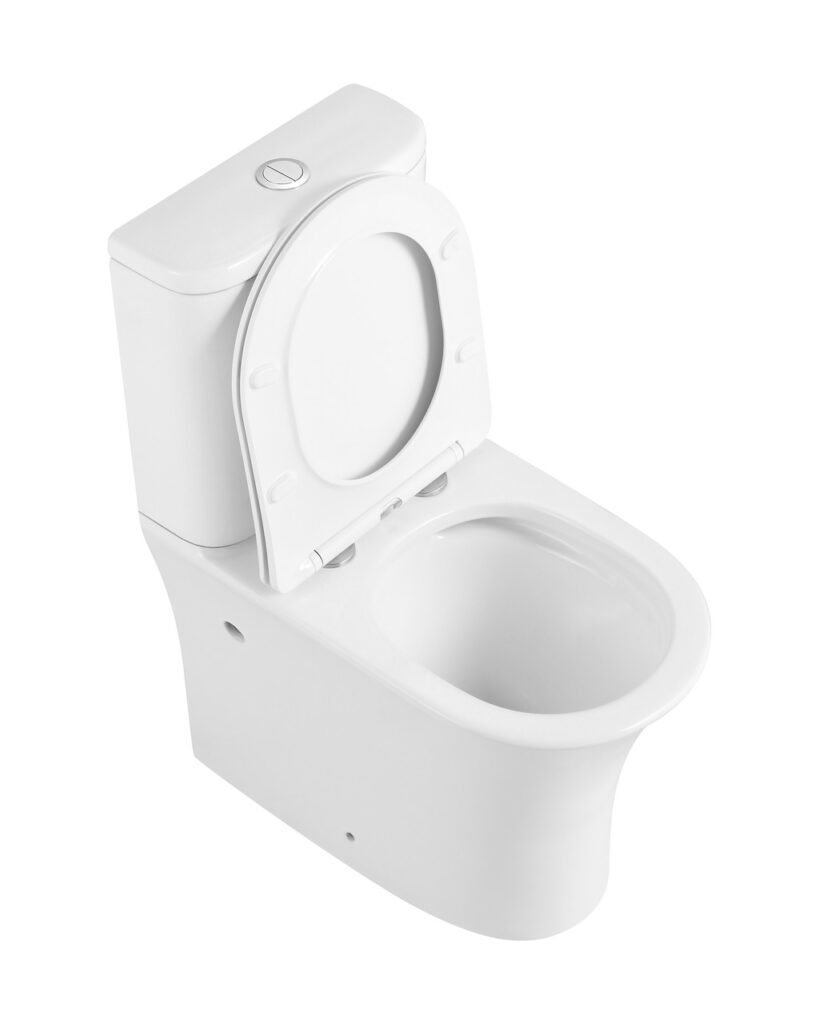
The scope covers close-coupled suites, one-piece suites, and independent WC pans, including pans with an integral trap and the cisterns matched to them. The phrase “integral trap” is in the title for a reason: the trap is part of what is being assessed, because the trap is where the water seal lives and where a blockage begins.
What follows from that scope is practical. The object of the test is a pan and its trap as one article, assessed with the cistern it is matched to. If your project specifies a pan and a separate concealed cistern from a different source, you are outside the arrangement the standard describes, and the assessment on the pan does not speak for the combination. That is a design decision, not a defect, but it belongs in the file rather than in an assumption.
The flush volume classes
EN 997 works with nominal full flush volumes of 4, 5, 6, 7 and 9 litres. Nominal is the operative word. The product is declared and assessed within a class, and the class is what appears in the documentation, rather than a figure measured on site with whatever pressure the building happens to supply.
For a specifier, the class is a design input: it tells you what the fixture is intended to deliver, and it lets you compare two products on the same basis. For an installer, it is a reminder that the class assumes a supply and an installation within the conditions the test assumes. A pan assessed in one class and installed on a system that cannot deliver the conditions is not a pan that failed the standard. It is a pan outside the conditions the standard was written around.
Water seal depth and wash of bowl
The water seal depth test measures the depth of the water standing in the trap after a flush, because that standing water is the barrier between the drain and the room. A shallow seal is an odour path, and it is an odour path that appears in normal use rather than in a fault condition. It is measured after the flush, which is the only moment that matters: the depth while the cistern is filling is not the depth the next user lives with.
The wash of bowl test addresses a different failure. A flush can clear the sump and leave the sides of the bowl untouched, and the result is a fixture that smells clean in the trap and does not look clean above the waterline. The wash test assesses what the flush does to the bowl surface, which is the part a user sees and the part a cleaning regime has to compensate for if the flush does not reach it.
Both tests are about the same question asked in two places: does the water go where it is supposed to go. One asks whether it stays where it should, the other whether it reaches where it should.
Paper clearance and ball clearance
The paper test uses twelve sheets of toilet paper, and the requirement is that at least four out of five flushes clear them. It is a transport test with a tolerance built in, which is what makes it credible: a standard that demanded five out of five would be a standard written to be failed by a product that works in ordinary use.
The ball test uses fifty plastic balls, and it measures whether the flush moves a load through the trapway rather than around the bowl. Between them, the two tests cover the two materials that cause most of the trouble in a real bathroom: paper that clumps, and solids that float.
Neither test is a statement about a plumbing system. They are statements about a fixture under the conditions of the test. A pan that passes both can still block on a drain with insufficient fall, and that is an installation question rather than a product one.
Oversplashing and after-flush volume
Oversplashing is the test that catches the flush which is powerful in the wrong direction. Water that leaves the bowl, whether over the rim or out of the fixture, is a defect that shows up as a wet floor rather than as a blockage, and it is easy to miss in a showroom because nobody flushes a display model hard.
After-flush volume records what is left once the flush has finished. It matters because the end of one flush is the beginning of the next: the state the fixture is left in decides the seal, the surface and the starting condition for the following use.
Read the list that way and the standard stops looking like a formality. Every test is a defect that somebody had to deal with often enough to write a method for it.
Three standards that do not interchange
EN 997 is the European standard for this product. AS 1172.1 is the Australian product standard a WC pan is assessed against under WaterMark. ASME A112.19.2 is the American equivalent. They are three different documents with three different test sets, three different scopes and three different sets of acceptance criteria.
A result under one of them is not a result under another. A pan assessed to AS 1172.1 has not been assessed to EN 997, and a report quoting one cannot be read as evidence for the other. That sounds obvious written down, and it is routinely blurred in supplier documentation, where a row of standards is presented as though the product satisfies the set.
For a buyer the practical rule is to match the standard to the market, and to ask for the report that names the market’s standard. If a supplier cannot produce a report under the standard your market applies, the honest answer is that the product has not been assessed against it — which is different from the product being bad, and different again from the product being approved.
What to ask us for
We do not present EN 997 testing as held across the range. What we hold and publish is specific: an AS 1976 test report recording water absorption of 0.14%, WaterMark certification on the models it covers, CE marking on our wall-hung models, a WELS rating of 3.5 stars, ISO 9001 for the plant at Chaozhou, and two SGS VOC reports.
If your project specifies EN 997 and needs a report under it for a particular model, ask for that model. We will tell you what exists, and if nothing exists we will say so rather than send a document about a different standard and let the difference be discovered by your reviewer. Any approval we hold that is not published on the site is provided as certificate documents on request.
Frequently asked questions
Does EN 997 test how a toilet looks?
No. It tests construction and performance: water seal depth, wash of bowl, paper clearance, ball clearance, oversplashing and after-flush volume, among other requirements. Appearance is not what the standard is for. A fixture can be assessed and still not match the design intent of a particular bathroom.
What flush volumes does EN 997 cover?
The standard works with nominal full flush volumes of 4, 5, 6, 7 and 9 litres. The volume is declared and assessed as a class rather than measured on site. Which class a project should specify is a design decision that sits with the specifier, not with the standard.
Which products fall inside the scope?
Close-coupled suites, one-piece suites and independent WC pans, including pans with an integral trap, together with the cisterns matched to them. A pan supplied with a separate cistern from another source is outside the arrangement the standard describes, which is worth noting in a project file.
Is EN 997 the same as AS 1172.1?
No. EN 997 is the European standard, AS 1172.1 is the Australian standard a WC pan is assessed against under WaterMark, and ASME A112.19.2 is the American equivalent. The scopes, tests and acceptance criteria differ, and a result under one is not evidence under another.
What does the paper clearance test require?
Twelve sheets of toilet paper are used, and at least four out of five flushes must clear them. The tolerance is part of the design of the test: it reflects ordinary performance rather than a laboratory ideal, and it is the reason the result is meaningful when it is reported.
Do you hold EN 997 test reports?
We do not present EN 997 testing as held across the range. Tell us the model and the standard your project applies, and we will confirm exactly what documentation exists for that model. Anything held but not published on the site is provided as certificate documents on request.
Related on this site
Documents and certificates
- Published test reports, catalogues and drawings
- Certificates and the markets each one covers
- Ask for a report against a named standard