
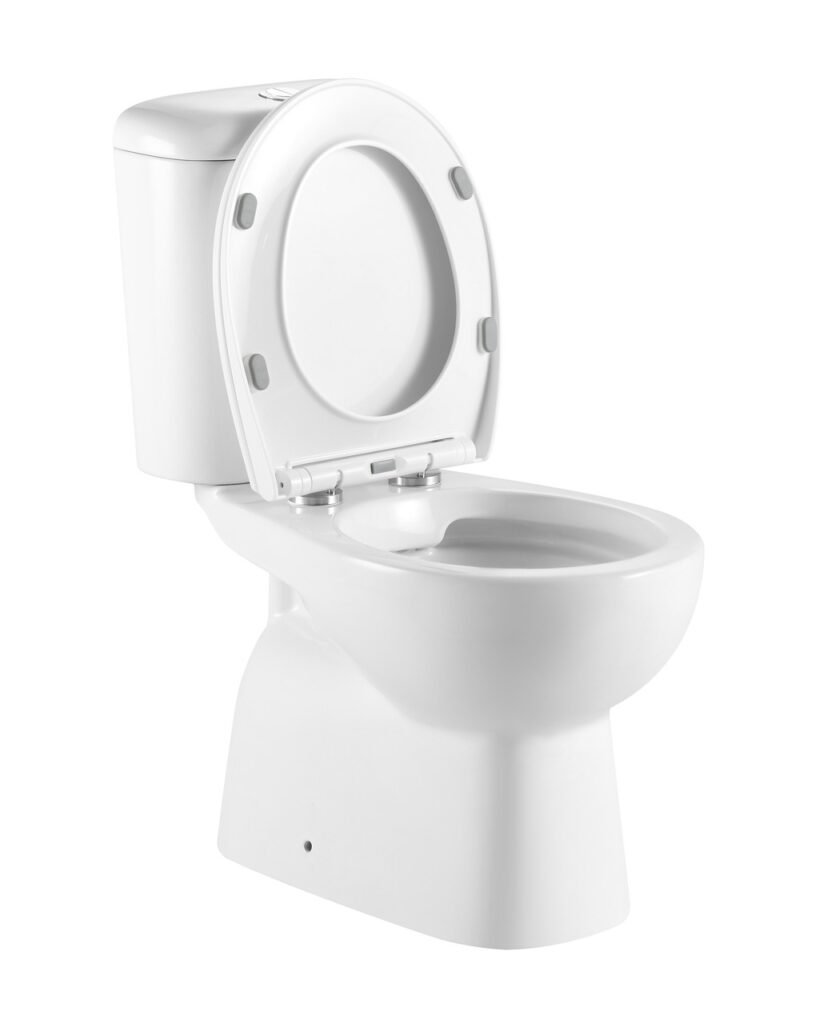
What the trap is, and what the rough-in is
Every WC pan carries a trapway: the passage inside the ceramic that carries waste from the bowl to the drain. The shape of that passage is what P and S describe. A P-trap turns the flow towards the wall; an S-trap drops it through the floor. The letter is not a brand, a quality grade or a price tier. It is the direction the drainage leaves the pan.
The rough-in is a distance, not a fitting: it is measured from the finished wall behind the pan to the centre of the drain. On a floor drain it is the distance from the wall to the drain centre in the floor. Both numbers belong on a drawing before they belong on a purchase order, because a pan that arrives with the wrong trap arrangement cannot be made to fit by the installer, however good the ceramic is.
Why P-trap and S-trap are not interchangeable
The two arrangements follow the building, not the catalogue. If the drainage leaves through the wall, the pan has to be a P-trap. If it goes through the floor, it has to be an S-trap. A supplier who answers “trap: yes” has not answered the question, and a quotation that omits the trap has not quoted the pan you can install.
The practical consequence is that the trap has to be settled at the specification stage, together with the mounting. Mounting and trap are two separate decisions that are often confused: a wall-hung pan is fixed to the wall but can still drain in either direction, and a floor-standing pan is not automatically an S-trap. One is how the pan is carried; the other is where the water goes.
Where our spec sheets state it
We state the trap arrangement against the individual model rather than against the series, because the values differ inside a family. Two pans that share a name can be recorded differently:
- 6009C MASSA-P is recorded with a P-trap roughing-in as standard.
- 6009 MASSA-S, the same family name, is recorded with an S-trap at 140 or 250 mm.
- 6013 VENICE and 3366 are recorded with S-traps, at 140 mm and 100 mm respectively.
- 6004 JUVE and 6066 JESI are each recorded with a P-trap at 180 mm and an S-trap option, so the choice is made on the order rather than at the wall.
Every model in the catalogue also has a printed technical drawing — front, side and top views with the dimensions in millimetres, indexed by the printed code — and the drawing set covers 100 models, one sheet per model. Both the catalogue and the drawing set are open access on our downloads page, with no login and no form, so you can check a pan against its own sheet before you ask anyone for a price.
The 180 mm figure, and what it does not mean
180 mm is the roughing-in figure recorded for most of our toilet range. It is worth knowing because it tells you the range is built around one common floor-drain layout, which is why a mixed container of floor-standing models is practical to specify.
It does not mean 180 mm is your rough-in. The distance that matters is the one measured on your site, and the figure that matters is the one printed against the model you are actually shipping. Where a model is recorded with a range of S-trap dimensions — as several of ours are — the range describes what the trap set can be adjusted to, and the choice still has to be fixed on the order. Reading a range as “it will fit anything” is the single most common way a first container ends up with the wrong pans.
How to write the trap into an RFQ
Five lines remove the ambiguity. They take a few minutes at the specification stage and they are what a factory needs to quote a pan you can actually install.
- The trap: P or S, stated as a requirement rather than a preference.
- The rough-in figure, measured on site rather than assumed from a similar project.
- The mounting, kept separate from the trap in the same line of the request.
- Written confirmation that the model quoted carries that trap arrangement — not that it is available in the series.
- The drawing sheet reference, so that both sides are reading the same numbers.
Frequently asked questions
What is a toilet rough-in?
The distance from the finished wall behind the pan to the centre of the drain. It is the dimension that decides where the pan sits, and it is measured on site rather than taken from a catalogue or from a similar project.
Is 180 mm a standard rough-in?
180 mm is the figure recorded for most of our toilet range, and it is a common floor-drain layout. It is not a universal standard: your site has its own distance, and a model can be recorded with a range of S-trap dimensions rather than a single figure. Take the number from the sheet for the model you are buying.
Can an S-trap pan be used on a wall drain?
No. The trap follows the drainage in the building, so a wall drain needs a P-trap and a floor drain needs an S-trap. Where a model is offered in both, the choice is confirmed on the order.
Do your models come with both trap options?
Many do, and the product page states it in the form “S-trap and P-trap options on the spec sheet”. Read that as a choice to be made on the order, not as both arrangements shipping in the crate. Some models are recorded with one arrangement as standard, and 6009C MASSA-P is an example of a P-trap standard.
Where do I find the rough-in for one specific model?
In the technical drawing set on our downloads page: one sheet per model, front, side and top views, dimensions in millimetres, indexed by the printed code, covering 100 models. The sheet for the printed code is the reference to quote.
Does the trap affect how the toilet flushes?
They are separate attributes. The trap describes where the waste leaves the pan; the flush value describes the system that moves it. A flush name tells you nothing about the trap, and a trap tells you nothing about the flush — both are stated separately for each model.
Related on this site
Models with a P-trap recorded as standard
Models with an S-trap recorded
Models recorded with both options
- 6004 JUVE — P-trap at 180 mm and an S-trap option
- 6066 JESI — P-trap at 180 mm and an S-trap option
- 6082 — S-trap option recorded at 160 mm and 250 mm
Documents, range and terms
- Technical drawings — one sheet per model, indexed by printed code
- The whole range, 89 models
- Send the rough-in and the trap — we will name the model