
The ceramic half is the easy half
Our smart toilets are cast, glazed and fired on the same lines as everything else in the catalogue, so the porcelain side of the job raises the same questions as any WC: body, glaze, dimensions, packing. The difference is what sits inside and behind it — an instant-heating element, a seat heater, a control board and a remote. That makes a smart toilet an electrical appliance that happens to be made of vitreous china, and it moves three questions to the front of the brief.
What sits in the range now
Eleven models, across four ways of installing them. Every one shares the same flush principle — wash-down, Tornado — and the same UF/PP seat and cover. What changes is the body and where the waste goes, and that is the part that decides whether a model fits the roughing-in a project already has.
- Built-in water tank, floor-standing — M303 and M503 at 638 × 385 × 445 mm with S-trap 80–120 mm; M30 at 660 × 395 × 455 mm with S-trap 80–105 mm; M531 at 678 × 395 × 455 mm and M530 at 678 × 395 × 480 mm, both S-trap 125–230 mm; M532 at 700 × 395 × 455 mm with S-trap 125–230 mm. All six take a 180 mm P-trap roughing-in, and optional S-trap sets are printed per model on each product page.
- Back-to-wall — M6530 at 730 × 410 × 845 mm, the tallest of the eleven, with the cistern carried in the body; S-trap 160–260 mm and a 180 mm P-trap roughing-in.
- Wall-hung — M2530 and M2531 at 600 × 385 × 420 mm, no floor contact, 180 mm P-trap roughing-in.
- Wall-face — M3530 and M3531 at 600 × 385 × 480 mm; S-trap 115–140 mm and a 180 mm P-trap roughing-in.
The S-trap and P-trap figures are published per model on each product page and printed in the smart catalogue. Compare them against the roughing-in before anything else — a smart toilet that does not reach the waste pipe cannot be installed, whatever else it does well.
Voltage and frequency are settled at quotation, not at packing
Mains power is not universal. 100–120 V at 60 Hz covers North America; most of Europe, the Middle East, Africa and Australia run 220–240 V at 50 Hz; Japan is the well-known exception, running 50 Hz in the east and 60 Hz in the west. A unit built for one grid does not work on the other, and the fix is not a plug adapter.
State the configuration you need when you ask for the quotation, and get the confirmation in writing before samples. It belongs in the order specification next to the model code, not in an email thread a month before loading.
- Voltage, frequency and plug type — or a statement that you will fit your own plug
- Written confirmation that the exact model is built in that configuration
- The destination market, because a smart toilet attracts the electrical-safety regime as well as the sanitary-ware marks
Water pressure decides whether instant heating delivers
A tankless smart toilet has no cistern to buffer the supply. It heats water as it flows, so the result depends on how much water arrives and how fast. In buildings with healthy mains pressure this is not a consideration. It becomes one on high floors, in gravity-fed installations and on weak or intermittent supplies — the unit still flushes, but the wash function underperforms and the buyer blames the product.
Treat inlet pressure as a specification item and measure it on site rather than assuming it.
- Ask for the minimum working pressure of the model, in writing
- Measure the pressure at the installation point, not at the building entry
- Settle in advance whether the site needs a booster or a cistern-fed arrangement
Spares and support decide the ten-year cost
The ceramic body in a smart toilet will outlive the electronics inside it. Over a ten-year life it is the control board, the heater or the seat assembly that fails, so the questions that matter are about the parts chain rather than the showroom floor.
- Which components are field-replaceable, and which have to go back to the factory
- Whether a spare-parts list and part numbers ship with the order
- What the warranty covers on the electronic assembly, as distinct from the ceramic
- Who administers a claim in your market — you, or us through you
Our standard warranty is the ceramic body for life and fittings and parts for five years. Ask us to confirm the electronic-assembly terms against the model you are quoting and have them written into the order, so the first failure is a parts order rather than a negotiation.
Compliance travels with the electronics as well
For the ceramic range, certification is a market-entry question: CE for the EU, WaterMark and WELS for Australia and New Zealand, SASO for Saudi Arabia, CIDB/SIRIM for Malaysia. A smart toilet carries those same considerations plus the electrical-safety dimension of the destination market, and the two are not the same document. Tell us the market when you brief us and we confirm the position for the exact model before sampling, exactly as we do for the ceramic range.
Where the range stands today
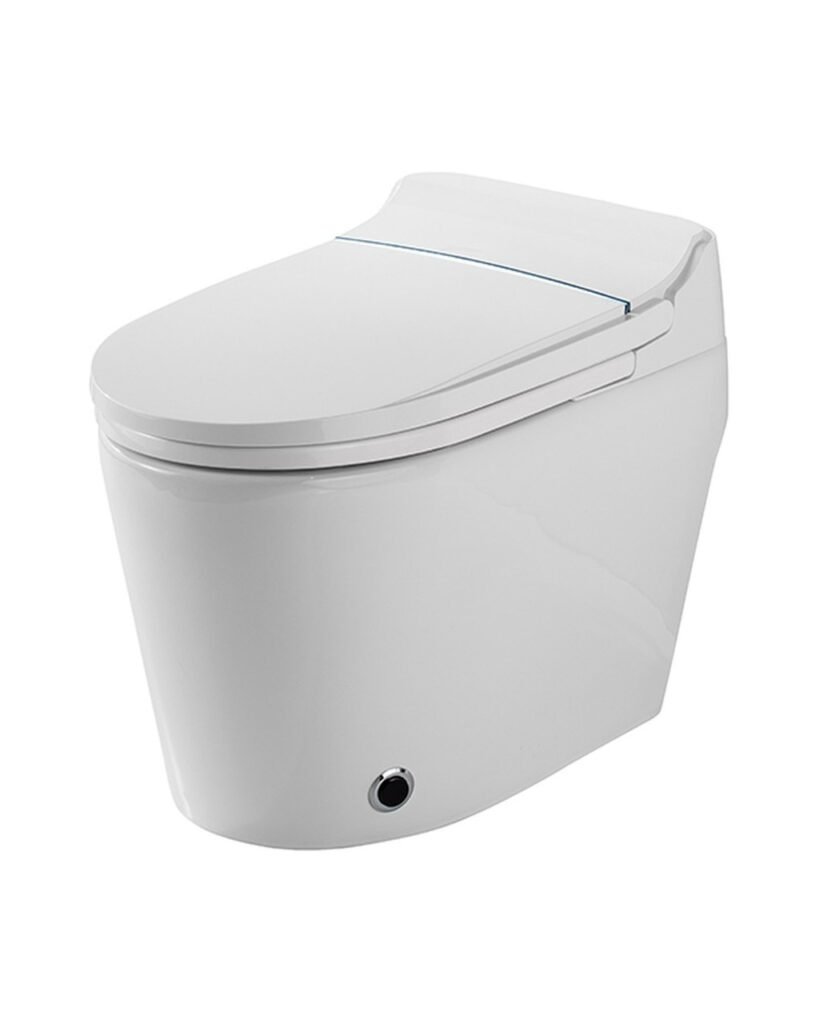
SMART-1 is our integrated floor-standing smart toilet: tankless with instant heating, remote control with touch flush, heated seat and bidet wash. It is not a separate product line bolted onto the catalogue — it is produced in the same Chaozhou plant as the two-piece, one-piece and wall-hung WCs and the bidets, a 51,000 m² facility with dedicated casting and firing lines. The smart range has its own catalogue, downloadable without a login.
Send three parameters with the inquiry
Voltage and frequency, the measured supply pressure at the installation point, and the destination market. With those three we can quote the configuration that will actually work, confirm the certification position and give you a lead time that holds. Samples are free of charge on catalogue models; freight is the only cost we discuss.
Related on this site
- M303 — floor-standing smart toilet with a built-in water tank
- M6530 — back-to-wall smart toilet
- M2530 — wall-hung smart toilet
- SMART-1, our integrated floor-standing smart toilet
- The 2026 smart toilet catalogue and the technical drawings
- Send us voltage, pressure and destination market